- Canadian & World History
- Posts
- The Real Father of Manitoba
The Real Father of Manitoba

Epoch Magazine
July 07, 2025
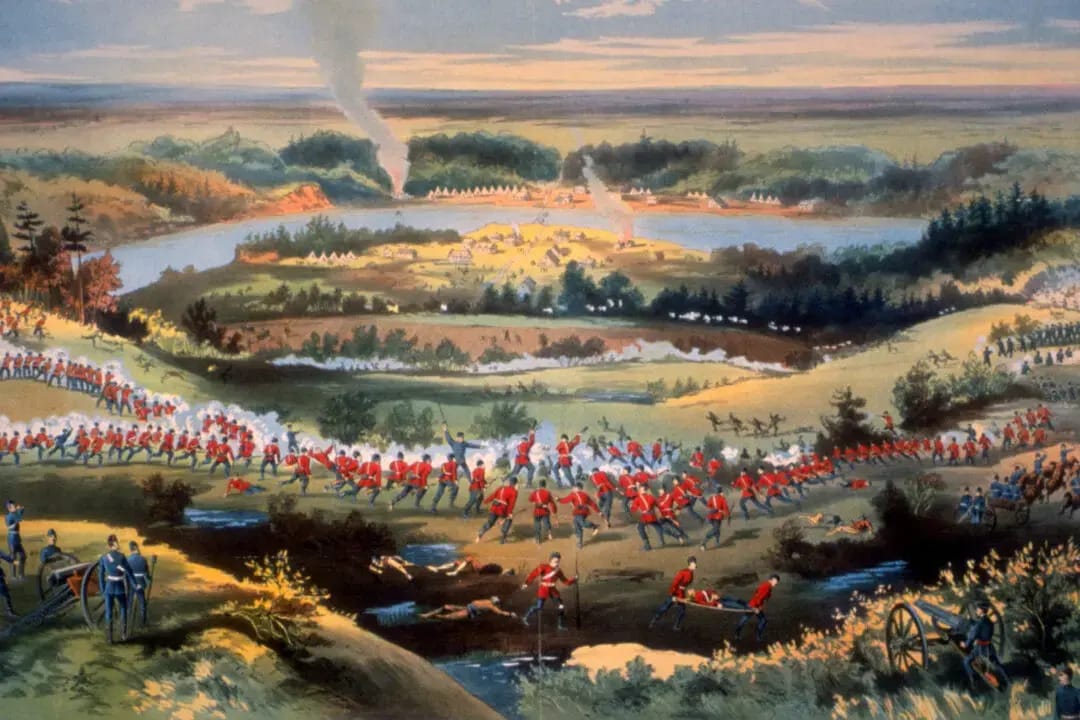
Depiction of the Battle of Batoche during the North-West Rebellion in 1885, an encore to the Red River Rebellion of 1869. (Public Domain)
Commentary
Louis Riel has long been called by some the Father of Manitoba. Though the province’s website is equivocal (saying only that he is “widely regarded” as such), last year Manitoba one-upped itself. Supposedly “correcting history,” Premier Wab Kinew declared Riel the province’s “first Premier”—a position that not even Riel imagined he ever held and that he was never sworn into.
The first chief executive of Manitoba was an Englishman named Alfred Boyd, remembered only, if at all, because he “drew many laughable sketches of members of the House that were grotesquely funny.” By contrast, Riel is one of the few historical figures recognized by Canadians.
Few would deny that Riel was a critical figure: his resistance, or rebellion, in 1869 (with an encore in 1885) put the Dominion of Canada’s survival in serious jeopardy, if only briefly. But much more than Riel, the man who in fact spoke articulately and rationally for the Métis people of Red River Colony and the one who played diplomatic hardball with Sir George-Étienne Cartier was a certain Noël-Joseph Ritchot—the bluff, tough, but prudent Catholic priest who actually sat at the table to secure his people’s rights in the Manitoba Act of 1870.
It was Ritchot, not Riel, who was Manitoba’s Father of Confederation.
The Métis of the 19th century were a magnificent people whose time was brief, overtaken by the march of history. But Riel was not really one of their great leaders. The true “captains” or “chiefs” of the Métis were men like Cuthbert Grant (1793–1854), known as “Captain-General of all the Half-Breeds.” They were horsemen, trackers and guides, buffalo hunters, frontier fighters, farmers, fathers of many children.
These were men like Grant and Jean-Baptiste Wilkie (1803–1886), and of course the well-known Gabriel Dumont (1837–1906). They called themselves Bois-Brûlés, men of “burnt wood.” They celebrated their history in myth and song—victories over the “company men” and the Sioux. Supporters of authority, toughness, and order, they revered their multilingual Catholic priests, to whom they deferred on matters requiring education and worldly wile. Father Ritchot was one of them, parish priest and military-hunt chaplain since 1862.
 Drawing of Father Noël-Joseph Ritchot (1825–1905). (Public Domain) | Born on Christmas Day, 1825, at L’Assomption in Lower Canada, Ritchot was locally educated while working on the family farm. Ordained a priest in 1855, he soon conceived the dream of going to the North-West. Ritchot was inspired by these brave and learned priests. It is a cruel blow by postmodern historians that such missionary men, giants of Canadian history who laboured to learn native languages and culture, who lived among and close to their people—even creating alphabets for them because the indigenous had no systematic writing—are now vilified for the “loss” of indigenous languages. |
A tall, imposing figure with a great beard and large hands, Father Ritchot, 44 years old when the Red River Rebellion broke out in 1869, once scared off a would-be challenger to a fist fight by lifting a 100-pound sack of grain with one arm.
Riel, 24, returned to that world from Montreal, where he’d gone to study for the priesthood, then the law. He had dropped out of both, but he still had much to offer: a new kind of leadership. His father, Louis Sr., had been a farmer, “miller of the Seine” (a tributary of the Red River), and possessed some leadership qualities. The grandfather, Jean-Baptiste Riel, had been a voyageur from Lower Canada who married a Métisse, and so Louis Riel Jr. was only one-eighth indigenous.
 Louis Riel in 1884. (Public Domain) | Riel brought education, connections, and charisma. He spoke persuasively, as historian Thomas Flanagan has written. He seemed to be the man to stand up to the new imperial power, Ottawa. But he used those powers to lead his people into tragedy. Meeting in Father Ritchot’s rectory on Dec. 8, 1869, the Métis formed a military-style provisional government, with a president (Riel), council, and soldiers of the hunt. The glory of that moment had faded by Aug. 24, 1870, when they surrendered control of Upper Fort Garry to a military force led by Maj. Gen. Garnet Wolseley, “the very model of a modern major-general” who inspired Gilbert and Sullivan’s famous song in their comic opera, “The Pirates of Penzance.” |
Ottawa’s epic expedition was led by British regulars, augmented by an equal number of part-time reservists from Ontario and Quebec who eagerly volunteered to give Riel a whupping.
By then Riel had already fled, fearing vengeance for executing an Ontarian, Thomas Scott, who resisted Riel’s coup—the Canadian resistance to the Métis resistance. The scene was frighteningly like the Wild West, and impressively, Sir Charles Tupper went to Fort Garry in January 1870 to rescue his daughter, travelling by the U.S. rail system most of the way because Canada’s was not yet built.
Father Ritchot was the voice of reason in the Red River Colony that called itself “Assiniboia.” And so he went to Ottawa, together with a Scotsman, Judge John Black, and a hotelier named Alfred Scott who didn’t actively participate. Black and Ritchot met Cartier at his home a few blocks from Parliament. Cartier and Sir John A. Macdonald found Ritchot a lot flintier than they expected, and Macdonald withdrew to his old refuge, the bottle.
Father Ritchot was well briefed, trying hard to implement Riel’s instructions, and persistent, “not fully satisfied with the verbal assurances,” hammering away at Cartier until he got a good deal. Returning with much of what he had hoped for, Ritchot had negotiated provincial status, a guarantee of 1.4 million acres (Section 31 of the Manitoba Act), as Flanagan wrote in “Métis Lands in Manitoba” (which many of the Métis preferred to sell), and separate schools. Ritchot also thought he had obtained amnesty for the rebels—but that didn’t work out as he expected and he felt aggrieved to the end of his days.

Upper Fort Garry circa 1872. (Public Domain)
Though Riel made mistakes, Ritchot stuck by him. There were other, more conservative men among the Métis, like farmer, hunter, and office-holder Pascal Breland, son-in-law of the great Cuthbert Grant, who supported protection of his people’s rights while rejecting Riel’s violence. And there were peaceful advocates for those rights, too, at Upper Fort Garry who ironically were planning to build a chapel dedicated to “Notre Dame de la Victoire,” Our Lady of Victory.
But whose victory?
While at its birth Manitoba was 90 percent Métis, that population was soon displaced by waves of English-speaking migrants to Ontario’s first colony. In 1890, a Protestant majority made English the sole official language and made life more difficult for the French Catholic minority. They went against the great unifying spirit of Confederation with the Manitoba Schools Act, which cancelled state schools run by and for the minority. By then, many Métis had moved west to Saskatchewan and got caught up in the 1885 encore rebellion that ended in 10 executions—Riel’s and that of nine indigenous men who, excited by Riel’s folly, murdered a priest, an interpreter, a trader, a rancher, an Indian agent, and four farmers or farm instructors, at Frog Lake and Battleford.
Ritchot served another 20 years in the parish. He acquired tracts of land, some of which was sold to him by Métis, which he then sold to francophone new arrivals. He used that land as a resource with which to fight for minority rights, educate the young, build a new church, bring the Trappist monks to St. Norbert in 1892 (where they stayed for 86 years), care for orphans—and to remonstrate with Ottawa, until his death in 1905.