- Canadian & World History
- Posts
- ‘Noble Chain of Provinces’: More ‘Fathers’ of Confederation
‘Noble Chain of Provinces’: More ‘Fathers’ of Confederation

Epoch Magazine
July 02, 2025
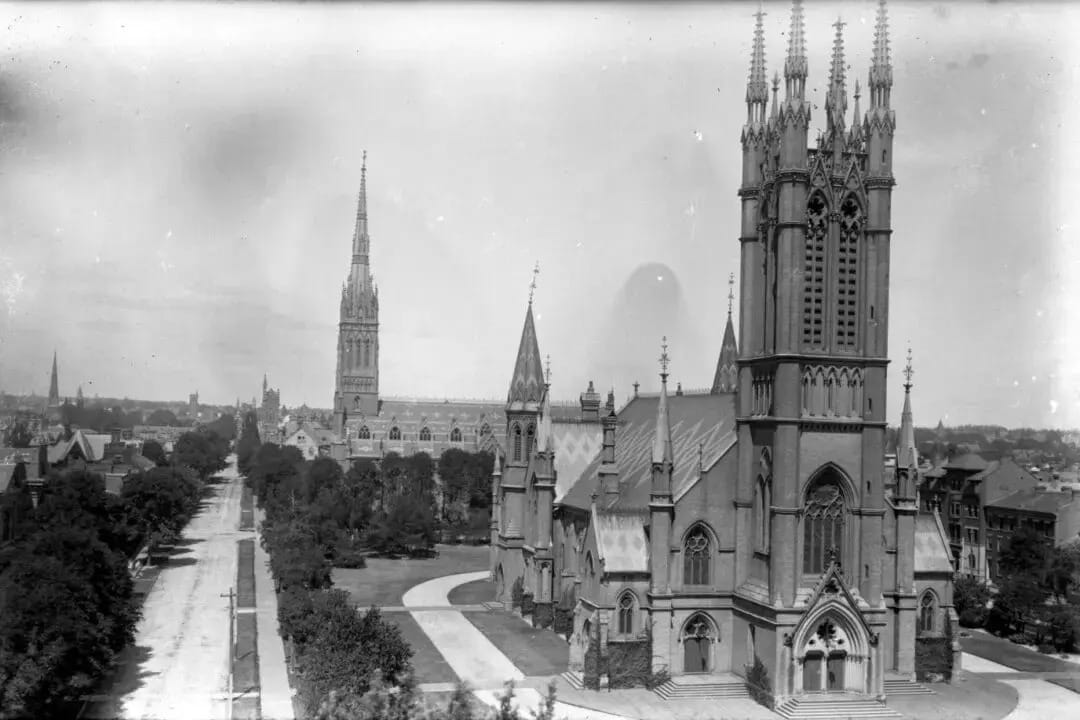
The Metropolitan Methodist Church (later Metropolitan United Church) on Bond Street in Toronto in 1896. (Public Domain)
Commentary
Roman Catholic bishops supported Confederation in the hope that a strong central government would protect Catholic minorities in Protestant-dominated Ontario and the Maritimes, two-thirds of the new Dominion. On the flip side, Protestant minority educators in Quebec looked to the same constitutional provisions to protect themselves.
Archbishop Connolly urged Charles Tupper, premier of Nova Scotia and a delegate to the Union conferences, to “go in for the rights of minorities, Protestant as well as Catholic,” according to “The Life and Times of Confederation” by Peter B. Waite. That topic was debated by the Fathers throughout the autumn of 1866.
There were English or Protestant schools all across the future Quebec, from Aylmer to the Gaspé, many in the Eastern Townships and Southern Counties. They were a big presence in Montreal, of course, dating back to 1816 with the Royal Grammar School, and there were many others. Father of Confederation Sir Alexander Tilloch Galt, champion of English-speaking Quebecers, made their protection a key principle.
For most Protestants, however, Confederation had more to do with strengthening the British connection and resisting American annexation. Another Anglican, Ashton Oxenden, Lord Bishop of Montreal, born in England in 1808, wrote in his 1891 memoir: “On our first arrival” in the 1840s, “the subject of Annexation to the United States was frequently mooted: but little is heard of it now; and I hope that the idea of this great rising nation becoming a humble appendage to another country is for ever silenced. … May the daughter land [Canada] win her independence under the fostering care of her noble parent!”
The Christian Guardian newspaper, voice of Toronto Methodists, wrote on March 14, 1866: “We earnestly pray that the Union, if it takes place, may tend to perpetuate our connection with the British Empire.” Later, with respect to Ottawa’s courtship of British Columbia, the Guardian warned on Nov. 18, 1868: “Confederation or annexation present the only possible alternatives, to every British North American province.”
Actually, Protestant “official church bodies were remarkably silent” on Confederation, wrote historian John Webster Grant. “Synods and conferences of the churches had virtually nothing to say about Confederation. Anglican bishops largely ignored it in their charges. Its consummation” on July 1, 1867 “was not marked by church services throughout the nation,” Grant adds, “although the Evangelical Alliance sponsored a united service of thanksgiving in Toronto.”
 Ashton Oxenden, Anglican Bishop of Montreal from 1869–1878. (Public Domain) | Protestant-affiliated newspapers were more vocal. George Brown’s Globe, popular among Presbyterians, Baptists, and other “free” church members, embraced Confederation to eliminate “French domination,” regain control of the resurrected Upper Canada (rechristened as Ontario), and secure rep by pop (representation by population). To them, Confederation was a divinely ordained solution. On Feb. 5, 1865, Brown told the Province of Canada legislature that Confederation was “the duty which an over-ruling Providence has placed upon us.” He “hoped that the new Dominion would endeavour to maintain liberty, and justice, and Christianity throughout the land.” |
In the Maritimes, the Presbyterian Witness, published in Halifax, was zealous for Confederation. Given how weak the new Dominion would be in military and infrastructural terms, the British connection was essential to deterring the United States from trying to annex the colonies and especially the North-Western territories. The Witness was keenly interested in a wider Union linked by a great railway to the Pacific where British laws and the Protestant religion would prevail.
The Methodists had themselves undergone a mini-declaration of independence in 1828. They cut ties with their American founders and united with British Wesleyans and their Lower Canada protégés in 1854 to create what eventually would merge with the Wesleyan Methodist Conference of Eastern British America and the Methodist New Connexion church into the Methodist Church of Canada. Was it not part of Christ’s message that the brethren should dwell together in unity?
 Francis Fulford, Anglican Bishop of Montreal from 1850–1868. (Public Domain) | As the Presbyterian Witness observed on Sept. 17, 1864: “Christianity is intended to be universal, not merely provincial or sectional. It is not to be cramped within Roman, Anglican or Scottish rules. We are not to impose our quiddities and oddities on those to whom we send the gospel.” That was easier said than done. But by 1884, six Methodist bodies had become one, which in 1925 merged with some of the Presbyterians and Congregationalists to form the United Church of Canada. “Canada has a fair prospect of developing into a nation which shall attain the respect of the world,” wrote the Christian Guardian on Jan. 1, 1868, one that will “present an example of safe progress and wise government, and take her full share in the work of the world’s regeneration.” |
It is a short hop from Victorian Methodist “world regeneration” to the (secularized) United Nations internationalism of Lester B. Pearson, the son of a Methodist minister born in 1897 in Newtonbrook, a town later absorbed into Toronto.
Confederation was contentious because Protestants in Ontario and the Maritimes disliked “separate schools,” meaning protection for minority schools. The Globe denounced them and Brown hammered away against them. Other papers like The Canadian Baptist, The Home and Foreign Record, and the Church of Scotland Presbyterians were lukewarm to Confederation, according to Grant.
“The chief drawback, in the eyes of many Protestants, was the entrenchment of the rights of denominational schools in the British North America Act. Baptists and Congregationalists especially, being fervent believers in the separation of church and state, could not greet with undiluted enthusiasm a nation that was founded on a violation of one of their basic principles,” Grant wrote. (In this case, “denominational” meant Roman Catholics and Anglicans, because the latter had the whiff of establishment and episcopacy about them.)
And so in Upper Canada, “many Baptists plumped for outright separation,” with no federation. Suspicious of French Canada, hard-working farmers did not trust slick commercial interests either. That the colonies would be joined by railways was seen as a liability by those who associated commercial ambition with the service of Mammon, not God. “The Protestant conscience was shocked by the crass commercialism of politics in the railway age,” Grant says.
One prominent Anglican, Francis Fulford (1803–1868), Lord Bishop of Montreal before Oxenden, was less interested in Confederation than the borders of Anglican dioceses. “When the confederation of the Provinces has been effected,” he told a pan-Anglican synod at Christ Church, Oxford University, in 1866, “it will be desirable that at least the boundaries of the territory for Ecclesiastical and Civil Government should be conterminous.”
Fulford’s banal preoccupation probably shows how natural a step Confederation seemed to self-assured Protestant leaders. More stirring was the Canadian Methodist Magazine, which declared in 1875: “This noble chain of provinces must not be broken up, to be piecemeal swallowed by the neighbouring Republic.” Instead, “welded together in indissoluble phalanx, it will, we trust, develop a grand Christian civilization in accordance with the time-tried principles and noble constitution which it inherited from the dear old Fatherland across the sea.” Now, that was the spirit of Confederation!