- Canadian & World History
- Posts
- Charlie Brown and Franz Stigler: Honor Among Enemies
Charlie Brown and Franz Stigler: Honor Among Enemies
A German fighter pilot’s decision to aid a disabled B-17 saved the crew and forged a friendship.

Epoch Magazine
August 02, 2025
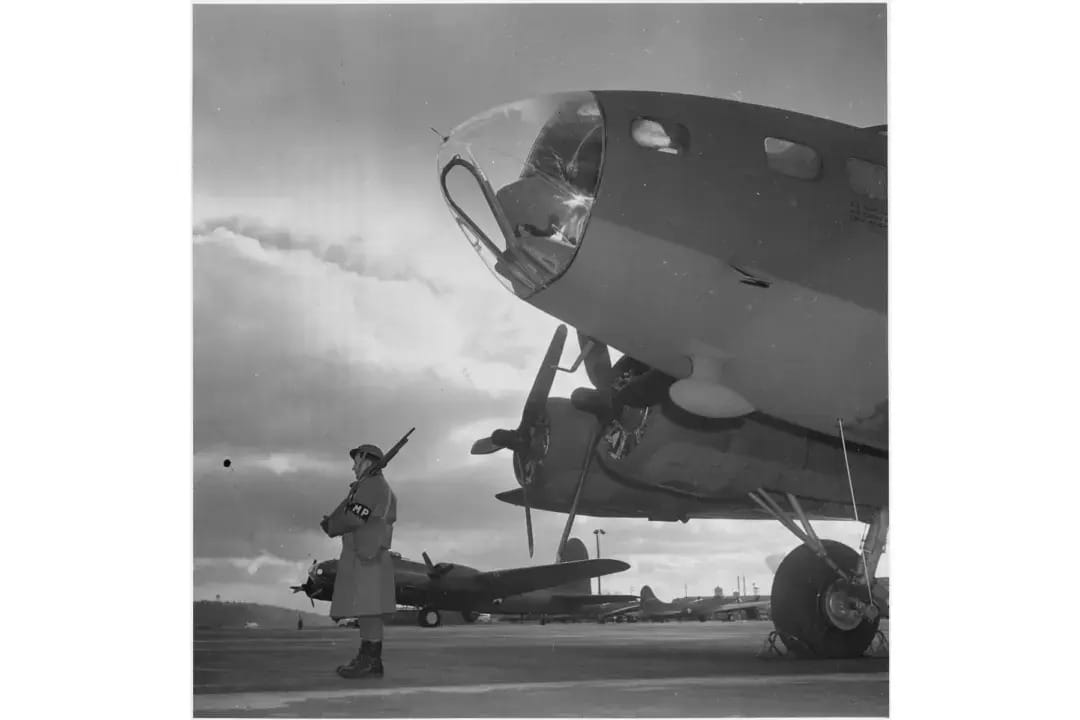
An Army sentry guards new B-17F (Flying Fortress) bombers at the airfield of Boeing's Seattle plant. (Public Domain)
During World War II, a German fighter pilot chose not to shoot down an American B-17 bomber during a battle. The bomber’s American pilot, Charles “Charlie” Brown, always wondered why. More than four decades later, the two would meet again and become friends for several years until they both passed away just months apart.
It was five days before Christmas in 1943. Brown, 21, was piloting a B-17 on his first mission. He was ordered to attack a German fighter plane factory. Brown’s plane, coined “Ye Olde Pub,” was put into lead formation near the site and quickly started taking heavy fire.

Crew of Ye Olde Pub. Standing (L–R): Coulombe, Yelesanko, Pechout, Jennings, Eckenrode, and Blackford. Kneeling (L–R): Brown, Luke, Sadok, and Andrews. (Public Domain)
About two minutes before they could drop their bombs, Brown and his crew met a barrage of anti-aircraft gunfire. Then, they were blasted by shelling from 15 German fighter jets. Brown’s plane took on serious damage, including a shattered nose cone and damaged electrical and oxygen systems. Three of the plane’s four engines were inoperable. One of the 10-member crew was killed by enemy air fire, and only one crew member wasn’t incapacitated by injury.
 Charlie Brown, circa 1943, when he piloted a B-17 over Germany. (Public Domain) | Veteran German fighter pilot Franz Stigler, who had 28 kills among 487 combat missions, was on the ground refueling and removing a bullet from his plane’s radiator. Directly over him, he could see the B-17 bomber limping by at a low elevation. Knowing it would be an easy target, Stigler took off again in hopes to score one more kill. This would assuredly earn him the Knight’s Cross award, the highest military decoration given by Nazi Germany during WWII. Brown, oxygen-deprived and wounded in the right shoulder by shrapnel, decided his only chance was to try to limp his plane back to England. Shortly after he leveled the B-17, he noticed a German fighter plane flying just off his wing. |
As Stigler approached the Ye Olde Pub, he noticed that the plane had sustained heavy damage. He could see inside the plane and noticed the crew was injured and incapacitated.
Warrior’s Code
Stigler’s first instinct was to shoot down the plane and earn the Knight’s Cross. But he suddenly had a change of heart. Early in his military days he was told by a senior officer that shooting down a man in a parachute was dishonorable. As he looked at the plane struggle to stay in the air, he felt that downing it would be equivalent to shooting down a parachute. It would violate the “Warrior’s Code.”
At first, Stigler tried to motion to the crippled plane to land in Germany and surrender. Brown and his crew either couldn’t understand what he was saying or simply refused. Brown kept flying. Stigler made one more unsuccessful attempt to get the plane to land in Sweden where they could receive medical attention.
 Franz Stigler in 1945. (Public Domain) | As the B-17 kept flying, Stigler decided to escort the plane through German airspace to prevent anti-aircraft missiles from firing on it. Though it was honorable, Stigler knew if anyone found out what he had done, he would be court-martialed and executed. As Brown’s plane left German airspace, he ordered his crew to turn a gun towards Stigler’s fighter jet in an effort to warn him off. Knowing that he was no longer in German airspace, Stigler saluted Brown and his crew before peeling his plane off and returning to Germany. |
Brown landed in England, with no fuel left, and was confused as to what just happened. However, he was warned by a superior officer to never mention what took place because they didn’t want soldiers having any positive views of the enemy. On the other side of enemy lines, Stigler returned, but he never mentioned what happened to anyone in fear of being executed.
Decades later during a pilot reunion in 1986, Brown reminisced about the incident. He had frequent nightmares about that day and he knew he needed to find Stigler. Brown searched for four years without result until Stigler responded to an ad Brown placed in a German war veteran newsletter.
Stigler had moved to Canada after the war and always wondered what happened to the B-17 he saved. After a quick phone call to prove that they were the correct fighter pilots, they chose to meet in person in a Florida hotel lobby.
Over the next several years, the two friends frequently visit each other and took trips together. Brown was saddened when his good friend Stigler passed away on March 22, 2008 at the age of 92. Brown passed away on Nov. 24, 2008 at 86 years old.