- Canadian & World History
- Posts
- Canada Bereft: The Spectacular Canadian War Memorial at Vimy Ridge
Canada Bereft: The Spectacular Canadian War Memorial at Vimy Ridge

Epoch Magazine
June 30, 2025

The Canadian National Vimy Memorial in northern France during a commemoration ceremony to mark the 100th anniversary of the Battle of Vimy Ridge, on April 9, 2017. (Philippe Huguen/AFP via Getty Images)
Commentary
On Nov. 11, 1918, the guns fell silent and World War I, the most horrific conflict humans had ever engaged in, came to an end. Almost immediately, thoughts turned to how to best commemorate and fix in the memory the battles and sacrifices of the war. Every nation (except Bolshevik Russia) that had participated in the struggle embarked on the design and construction of thousands of memorials, ranging from simple cairns or cenotaphs in villages, to triumphal arches and massive statuary groups in national capitals.
Canada was not exempt from this urge to solidify memory. At first, the government planned to memorialize battle sites in Europe with a series of identical monuments in Belgium and France, and held a competition for designs. When over 160 proposals were submitted in 1921, what emerged was overwhelming support for a single spectacular construction, based on a design by architect Walter Allward, on Vimy Ridge in the Pas-de-Calais region of northern France. After negotiations, on June 29, 1922, France agreed to donate land to Canada in perpetuity for such a memorial, provided Canada was responsible for its upkeep.
Why Vimy Ridge? By 1917, the German Army had occupied this height of land for three years, having incorporated its complex system of trenches and tunnels into a great defensive wall known as the Hindenburg Line. The ridge provided a clear line of sight over the surrounding countryside, including key roads, supply lines, and enemy positions. Whoever held it had a huge advantage in observing and directing artillery fire. Two previous French attempts to take the hill had ended in bloody defeat and over 100,000 casualties.
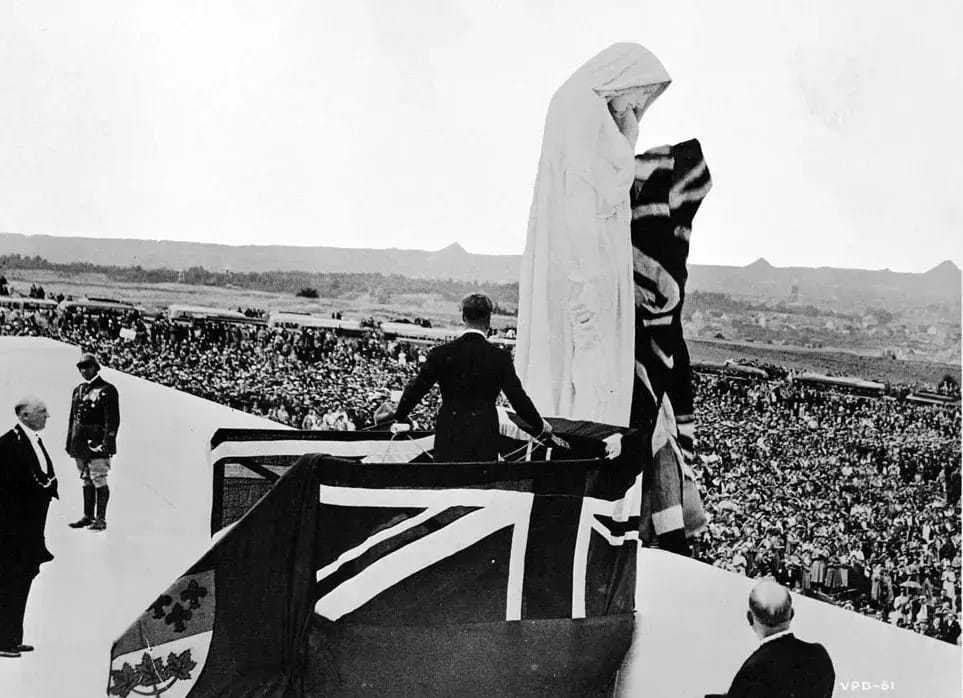
King Edward VIII unveils the Canada Bereft statue, also known as Mother Canada mourning the loss of her children, at the Canadian National Vimy Memorial on July 26, 1936. (Public Domain)
In 1917, the Canadian Army was assigned Vimy as their part in a wide Allied assault. Canadian officers held consultations with the French about lessons learned in the bloody struggle for Verdun; aerial photography provided data for maps and three-dimensional mockups of the target area. On the assumption that a disproportionate number of junior officers would be killed during the attack, care was taken to instruct sergeants and corporals in the objectives of their units with 40,000 trench maps distributed. For months, troops familiarized themselves with their objectives and trained in the new techniques.
Rather than a massive artillery assault that would cease when troops advanced—thus leaving the Germans plenty of time to regain their trenches—the artillery would continue, but creep forward in measured steps. New fuses would enable the shells to explode more easily and thus be more effective in cutting through the fields of barbed wire. Hundreds of miles of telegraph wire were laid to provide communications, and tunnels were dug to bring attackers more safely to the jumping-off point. The newly invented tanks would roll across no man’s land beside the infantry.

The Canadian National Vimy Memorial, dedicated to the 3,598 Canadian soldiers who died in the Battle of Vimy Ridge during World War I, northern France on Jan. 9, 2025. (Denis Charlet/AFP via Getty Images)
On April 9, 1917, four Canadian divisions, fighting for the first time as a national corps, began an attack on the German lines, preceded by a massive artillery barrage that launched over 1.6 million shells on the enemy. In three days of battle, the Canadians drove the Germans back three kilometres and took Vimy Ridge. The cost to Canada was 10,602 casualties (3,598 killed and 7,004 wounded), while German losses were in the 20,000 range.
The splendid monument was years in the making, partly because of the difficulty in finding and transporting exactly the right stone. The original plan called for white marble, but this was deemed to be too susceptible to erosion in the climate of northern France and builders chose instead a type of limestone found in Croatia; it had been used in Roman Emperor Diocletian’s palace at Split built 1,650 years earlier and was still in fine shape. Six thousand tons of the stone had to be quarried and moved to Vimy while 11,000 tons of concrete and hundreds of tons of steel were being employed on the foundation.
An enormous pilgrimage of veterans was planned for the official dedication in 1936. Politicians, military units, bands, and clergy were there in abundance, presided over by King Edward VIII, performing one of his few official duties before his abdication.
Unlike many other Allied monuments from the Great War, the Canadian monument at Vimy Ridge was not vandalized by the Nazis during their occupation of France. Apparently, Adolf Hitler appreciated the fact that our memorial was not glorifying war but mourning our dead. He ordered an SS guard mounted at the site and protected the monument from any damage.